Golden Gate Park and My Son’s Birthday

David's bench

David’s bench in Golden Gate Park in San Francisco. (Photo by Niles Dolbeare)

This week a San Francisco friend sent me a picture of a visit he paid to the bench my husband and I donated to Golden Gate Park in memory of our child. The inscription reads:

David Albert Loebl

2-19-56 to 5-24-93

Your love of life is with us always

The spot, near a small lake, is magic. A month before he died of AIDS, David and I picnicked near the future bench. I remember the gusto with which he bit into his pastrami sandwich and devoured the ketchup-drowned fries!

Even though I lost him, for me February 19th remains a joyous day of remembrance. See my blog, The Gay World As Navigated By a Straight Mom, for this year’s memories.

Posted in family stories | Tagged , , , , , , , , | Leave a comment

On the Measles Outbreak: Does the ‘Modern’ Anti-Vaccination Movement Remember Smallpox?

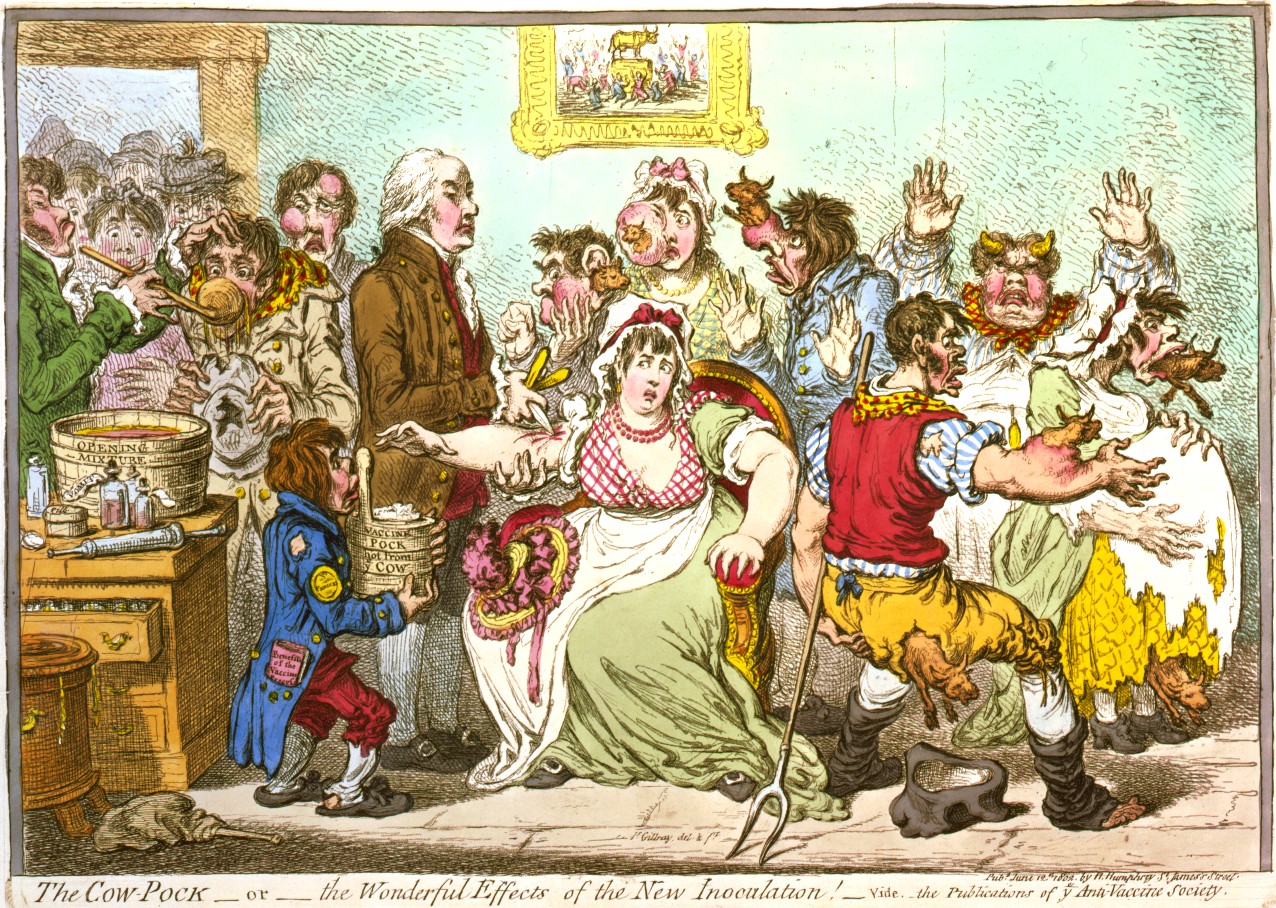
The Cow-Pock by James Gillray

The Cow-Pock, by British satirical cartoonist James Gillray.

I wonder whether the parents of the unvaccinated would consider doing away with traffic regulations or traveling by horse and buggy? Societal living needs written and unwritten rules and regulations.

It was humanity’s good fortune that Edward Jenner (1749-1823), an English country doctor, listened to a milkmaid who told him that she could not catch smallpox because she had had cowpox. Smallpox is a very ancient disease that killed Ramses V more than three thousand years ago. It has a mortality rate of 30% and, because it is airborne, it is infinitely more infectious than Ebola. Toward the end of the eighteenth century it killed 30,000 Englishmen annually. Many of those who survived were permanently disfigured.

Jenner tested the milkmaid’s folk remedy, and proved its veracity. In people cowpox is a mild disease. Dairy farmers whose scratched hands came in contact with the serum that oozed from a sick cow’s pox, caught cowpox and thereafter proved immune to smallpox. In 1796 Jenner harvested a bit of matter (serum) from a human pox that had formed on the hand of another dairymaid. He rubbed it in a scratch he had made on the arm of eight-year-old James Phipps. The boy developed a big pox, but remained fit. Six weeks later Jenner tried his very best to infect James with smallpox. But the boy was immune. Jenner called the process vaccination, a term derived from vacca, the Latin name for cow.

Then as now, some people were skeptical. In 1802 James Gillray published the above cartoon that illustrated the “cowyfying” effects of this vaccine. Nevertheless the vaccine has saved billions of lives.

The world quickly adopted vaccination. Within a few years Napoleon had his entire army vaccinated. In 1799, 23-year-old Thomas Jefferson traveled to Philadelphia to have himself vaccinated; soon thereafter he saw to it that his entire household was similarly protected. The discussion of whether or not to make vaccination compulsory has waxed and waned ever since. There was however enough worldwide legislation to force compliance, and in 1980 WHO declared smallpox an extinct disease.

It took many decades to understand the nature of infectious diseases, how diseases were transmitted and why Jenner’s vaccine worked. It took even longer to develop drugs and vaccines to treat these.

Most of the vaccines to treat common diseases—chicken pox, mumps, polio, yellow fever, influenza, some forms of pneumonias—date from the twentieth century. The discovery of each took gifted, hard-working scientists. They had to identify the causative agent, most often a virus, grow it, and then weaken it so that it could be administered to patients without causing the full blown disease. The measles virus was particularly difficult to grow and tame. The task fell to John Enders and his team at Harvard. It needed live cells to grow in and it took Enders years to develop the so-called tissue culture technique required to grow certain picky viruses. Enders’s technique was so world-shaking it earned him a Nobel Prize in 1954. Jonas Salk and Sabin used Enders’s technique to develop the polio vaccine in 1952. It would take Enders another six years to develop the measles vaccine. In its heyday measles was an especially bad disease, killing some of its victims, frequently causing blindness, encephalitis, heart disease in others. Even in 2011 it caused 158,000 deaths in underdeveloped countries. It had practically vanished in the United States. The reason that it is important to vaccinate the great majority of the population is that infectious agents survive by infecting susceptible hosts. When they can’t find a susceptible host they vanish, as the smallpox virus did.

Yes, I believe that the government or other agencies have the right and the duty to require its citizens to be vaccinated. We do need certain laws to keep functioning. Like most everybody else, I hate too much government interference, yet I expect those I elect and pay, to see to it that my water is clean, that they see to it that my neighbor and I dispose of our garbage, and that they do what they can to keep my children and me healthy. I also hope that scientists discover more vaccines. Who would not love one against cancer, AIDS or Ebola?

Suzanne Loebl’s first book, Fighting the Unseen: The Story of Viruses, was published in 1968.

Posted in politics | Tagged , , , , , , , , , , , | 1 Comment

Claude Frank: Pianist & Childhood Friend

Claude Frank

The last time I saw Claude Frank was after his performance at a Schneider concert at the New School. Though we rarely saw each other, we were always extremely happy when we met accidentally. These encounters were never planned, yet occurred every few years.

Claude and I shared a long distant past. My mother, born in 1902, Claude’s mother Irma, and her sister Ella grew up together in Nuremberg, Germany. They went to the same high school and dance classes where Irma met Lutz Frank, a future lawyer. They married and had two sons. Claude, the younger, obviously was a musical prodigy. His mother reported that he hummed music while being wheeled about in his baby carriage. Even though my mother left Nuremberg when she was twenty-two, she remained good friends with Frankfurt-based Ella who married a Mr. Heinzheimer, a very early victim of Hitler’s Dachau concentration camp.

Fast forward to 1938. Hitler took over Germany and fortunate Jews left their birth land. Claude’s parents had gotten divorced in Nuremberg but remained lifelong friends. Irma and Ella and their children relocated to Paris, where 12-year-old Claude went to school and studied piano at the Paris Conservatory. My nuclear family moved to Brussels, as did Lutz Frank, now an insurance agent. He visited us frequently as did Claude whenever he visited his father since he could not take care of him during the daytime. Claude and I became real good friends, mostly exploring a sand quarry near our house.

Brussels’s displaced German Jews formed a tight bond trying to take care of one another. One of their activities was to collect money for refugees in need. So it was that my mother organized a benefit piano recital that featured Claude. I remember addressing envelopes. The concert, perhaps Claude’s first, was a success. When the “phony” war started in 1939, Lutz packed up his insurance business, moved to France and volunteered for the French army, only to be interned as an enemy alien. So much for heroism!

The entire Frank and Heinzheimer family escaped to America illegally, climbing the Pyrenees and taking a boat from Lisbon to New York. My mother resumed a somewhat distant friendship with Irma and Ella. When Mom turned eighty I invited the sisters, as well as another 81-year-old “child” from their school, to lunch. I always thought that this was an amazing event, illustrating the vagaries of fate and firmness of human bonds. At this lunch the women bragged about the achievements of their offspring. There was Claude and his career, Ella’s daughter Ruth, an accomplished mathematician, and me, the writer. (Not bad, given that all of us were immigrants!)

By then Claude could look back on a fabulous career. He studied with Artur Schnabel, Maria Curcio and Serge Koussevitzky. At the height of his career he gave 70 concerts a year. He loved to play Mozart, Brahms, Schubert and especially Beethoven, recording his entire thirty-two piano sonatas in 1970 as part of the composer’s bicentenary. He was a member of the Boston Symphony Chamber Music Players. Claude taught at the Curtis Institute of Music, presented master classes at Yale and many other venerable institutions. Towards the end of his life, he concertized with his daughter Pamela Frank, a gifted violinist.

I have always regretted that time and other constraints prevent maintaining contact with many wonderful people one encounters in one’s life.

Posted in Uncategorized | Tagged , , , , , , , , , , , , , , | Leave a comment

Henri Matisse, MoMA, America, and the Rockefellers

In 1930, when the Museum of Modern Art was not even a year old, Henri Matisse came to America. The main purpose of his voyage was to visit Albert Barnes and to view the future site of the Dance Mural he had commissioned for his museum in Merion, PA. American collectors, including the four Steins, the Cone sisters of Baltimore, and Barnes, played a crucial role in Matisse’s early career. Indeed American museums own many of the painter’s iconic works.

Henri Matisse: The Cut-Outs at MoMA (October 12, 2014-February 10, 2015) will be a long-remembered exhibition. The works on view include the restored Swimming Pool, which the artist created for his dining room when age and disease limited his ability to get about. Indeed this joyous show includes several of such environments the artists created for himself. I particularly liked The Parakeet and the Mermaid filled with leaves, fruit and a small bird with which the painter identified.

Taken as a whole, the show is a tour de force of Matisse’s sense of color, design and technical skill. It all looks so simple! It is also particularly nice to experience these marvels during the darkest days of the year.

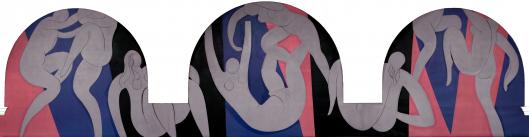
Henri Matisse's Dance mural, created for Albert Barnes.

Henri Matisse’s Dance mural, created for Albert Barnes.

One of Matisse’s earliest uses of his cut-out technique was for the Dance murals commissioned by Barnes for $30,000. The work gave the artist much trouble. Because of an original mistake in measurement, Matisse had to redo the entire work from scratch. Nevertheless, once it was finished and installed, Matisse wrote to his son Pierre: “When I see the mural before me, I find it superb.”

During his 1930 visit to New York, Matisse dined at the Rockefeller house on 54th Street. Though she was only one of three founders, to a large extent Abby Rockefeller founded MoMA. “Mother’s Museum” was a constant source of irritation between her and husband John D. Rockefeller Jr, who abhorred modern art. During that famous dinner Matisse tried to change his host’s opinion about art. Admiring Junior’s green, yellow, red, and black Chinese porcelains and his oriental rugs Matisse pointed out that these artists had relied on abstraction and vivid color, concepts that now influenced his work as well as that of Braque, Picasso and Juan Gris. Rockefeller refused to be convinced. (Abbreviated from Frank Crowninshield, Art and Mr. Rockefeller.)

One of the delights of the Cut-Out exhibition are Matisse’s stained glass windows. In 1952 he created The Christmas Window for Life magazine. It is now owned by MoMA. Its bright yellow star, colored leaves and background translate the magnificence of this world-wide holiday.

Rose window

Matisse’s rose window at Pocantico Hills, NY. (Photo by David Lee Tiller)

Abby Rockefeller died in 1948. Even though her friend Henri Matisse himself was aged and infirm, the Rockefeller family asked him to create a rose window for the small Union Chapel in Pocantico Hills, NY where they often worshipped when at Kykuit. At first Matisse refused because he was unfamiliar with the site, but he finally consented. A long exchange of letter and sketches followed between Matisse and Alfred Barr, MoMA’s director, who handled the commission. When Nelson Rockefeller read of the artist’s death on November 3, 1954, he figured that there would be no window. A few days later a letter, dated November 1, arrived. It stated that Matisse had happily concluded his work. The maquette for the rose window, created by Matisse’s cut-out technique, was found tacked to the wall of Matisse’s bedroom. The window was completed in France. Its delicately shaped glass petals, surrounded by two concentric circles of free-form yellow and blue-green glass, are part of America’s Matisse treasures.

*

For more details see Suzanne Loebl’s America’s Medicis: The Rockefellers and Their Astonishing Cultural Legacy (Harper, 2010).

Posted in Uncategorized | Tagged , , , , , , , , , , , , , , , , , , , , | 4 Comments

Christmas 2014: Other People’s Holidays

My mother was a Christmas junkie. I can still smell the pine aroma of the eight-foot tree that stood in our parlor in Hanover, Germany. Beeswax candles suffused the room with flickering light and a profusion of home-baked cookies weighed down the branches of the tree. Among the latter I was partial to tiny chocolate rings garnished with sprinkles and glazed cinnamon star cookies. For weeks prior to Christmas my sister and I had labored over handcrafted presents for my parents. These were now among the mounds of gifts spread out on tables adjacent to the tree. Even though they may have been reluctant about celebrating the holiday, my grandparents had sent gifts, including many characteristic German sweets. Parties of all kinds filled the week that followed, including one for my friends. During this event we prepared a meal with the cooking utensils of a good size dollhouse kitchen only set up during Christmas.

Rockefeller Christmas tree

The Christmas tree at Rockefeller Center, overlooking the ice skating rink.

The trouble was—as I learned all too soon—that Christmas was not really my holiday. We were German Jews, living in Nazi-land, and this lavish celebration actually was my mother’s revolt against her own parents, in whose house a Christmas tree would never be considered. Soon I became aware of the grown-ups discussing the dilemma of whether or not Jews should have a tree, and my family never had one after we left Germany in 1938.

My husband bought a menorah the year our daughter was born, and I did my successful best to arrange a festive eight-day candle-lighting festival for my children and then for them and my grandchildren. Just last week I cooked mounds of latkes (potato pancakes) for my family. I even could explain to my grandson’s new girlfriend that the holiday celebrates freedom, the victory of the weak against the mighty, and the fact that given the right faith and attitude, oil thought to burn for just one day can last eight.

I grew up in three countries, speaking three different languages: Germany (German), Belgium (French) and America (English) and identify with each one. I belong everywhere and nowhere—quite. Their holidays are mine—but not quite. Would I have it otherwise? No. I treasure being multicultural, though I do envy people who have never to hesitate to tell others where they hail from, or question their loyalties.

Tiffany's window display

A scene from Tiffany’s holiday window display this year.

And I do enjoy Christmas. This year, like most, I went downtown to admire the Christmas tree at Rockefeller Center, which I own—a little—since I wrote a book (America’s Medicis: The Rockefellers and Their Astonishing Cultural Legacy) that recalls that the tradition dates back to the construction workers who built the Center from 1929-1939 and decorated a smaller tree in 1931 at the height of the Great Depression. I also walk along Fifth Avenue and immerse myself in the fantastic windows the luxury stores mount for our delight. This year, Saks Fifth Avenue illustrates five fairy-tales—Rumpelstiltskin, Rapunzel, Cinderella, Snow White and Sleeping Beauty—in luxurious Art Deco style. The main characters, glamorously dressed in sequins and silk, are silhouetted against iconic New York buildings, images of a city in which I do feel utterly at home. Tiffany too celebrates my city with miniature cartoon-like characters and objects, all shopping for magnificent jewels. I use my new camera to share my imperfect pictures with you, my readers, and wish you a happy 2015.

Posted in family stories | Tagged , , , , , , , , , , , , , , | Leave a comment

Thomas Hart Benton’s Mural: America Today at Home in the Met

In 1930, at the height of the Great Depression, Alvin Johnson, the director of the twelve-year-old New School for Social Research, asked Thomas Hart Benton to paint murals for its boardroom. Murals were in. Just then Alfred Barr and Abby Rockefeller had invited Diego Rivera to exhibit his murals at their brand new Museum of Modern Art. Both artists were radical and their murals depict the transforming effects of industrialization on the world, referring to both its beneficial and detrimental effects.

Benton was a marvelous draftsman. Each one of his ten panels consists of a series of rich cartoon-like images consisting of workers performing their assigned tasks, circus acts, dancing couples, farm animals, boxing matches, or people reading their newspapers on New York’s subway, power plants, locomotives, Zeppelins and the like. Within each mural panel, individual scene are separated by metal strips. It takes many worthwhile hours to decipher it all.

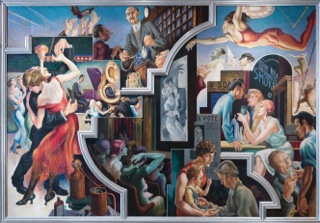
City Activities

City Activities

The cycle starts with the Deep South, with its white tenant sharecroppers, chain gangs and African-American cotton growers. Benton progresses to his own Midwest and Changing West with its industrialized wheat fields, pigs and typically decrepit horses. The next three panels depict Instruments of Power, Coal and Steel. Then it is the turn of the city: City Building, City Activity with Subway, and City Activity with Dance Hall, each with its own intricate imagery. Benton’s wife and child, as well as Alvin Johnson and the painter’s self-portrait, are part of the latter. Outreaching Hands fill a much smaller panel, now surmounting the entrance to the gallery, reminding the viewer that when Benton painted the panel America was in the grips of the Great Depression.

America Today had a checkered history and we are lucky that we can admire it in its entirety, beautifully restored to its original freshness. The New School’s boardroom eventually morphed into an ordinary classroom, where the paintings were at the mercy of busy and bored students. When the school sold it in 1953, the ten-panel mural was in the danger of being split up. Fortunately the AXA Equitable Life Insurance Company bought it for the company’s art collection and eventually exhibited in its lobby on Sixth Avenue. I admired it there regularly and made it a stop in my private tour of New York. In 2012, when the company planned to renovate its lobby, it gave the artwork to the Met, which restored it and gave it its own gallery in the American Wing. The gallery has the exact shape of the original New School boardroom.

Benton did not have much luck with his murals in New York. After he finished for the New School, the Whitney Art Museum commissioned Arts of Life in America to decorate its library. When the Whitney moved to its Breuer Building on Madison Avenue, it sold half of the mural to the New Britain Museum of American Art and the other half to the Chrysler Museum of Art in Norfolk, Virginia. It is wonderful that New York now has a complete, restored mural on permanent display at the Metropolitan. A temporary exhibit, featuring sketches, paintings and related material, is in an adjacent gallery.

Posted in Art review | Tagged , , , , , , , , , , , , , , , , | Leave a comment

An Homage to the Madame Cézanne Exhibition at The Metropolitan Museum of Art

Paul Cézanne painted 29 portraits, and made innumerable drawings, of Hortense Fiquet, whom he met in 1869. Paul, their son, was born in 1872. To legitimize him his parents eventually married in 1886. Dita Amory, the Met’s curator of the Lehman Collection,  and her staff succeeded in the formidable task of assembling 24 of these portraits. The paintings had never previously been united. This unique, intriguing exhibition will be on view in the museum’s Lehman Wing until March, 2015.

Madame Cézanne in the Conservatory by Paul Cézanne, 1891. Metropolitan Museum of Art.

Madame Cézanne in the Conservatory by Paul Cézanne, 1891. Metropolitan Museum of Art.

Hortense Fiquet is easily recognizable in Cézanne’s portraits, though each one is very different. Details vary little. She often sits on an arm- or straight chair, her hands clasped on her lap. In four paintings, she even wears the same red dress. She never smiles or aged during the twenty years it took Cézanne to complete the works, yet each of the portraits is unique. In the earliest one, dating from 1873-74, she is demure and shy.  Portrait number two, in which her shoulders are bare except for a necklace and her hair is free flowing, is the only one hinting at the couple’s intimate relationship. Most often Hortense’s expression is distant, stoic, sad, inscrutable, or introspective. One can feel the silence that reigned between painter and model.

My favorite portraits are the Met’s Madame Cézanne in the Conservatory and Boston MFA’s Madame Cézanne in a Red Armchair, perhaps because they are very familiar. They are also less stark. In both Hortense appears less dour and content. The plants that surround her in the conservatory makes it a beautiful interior. The pattern of the wallpaper and variegated stripes of the sitter’s dress are reminiscent of Van Gogh and presage Matisse.

Madame Cézanne in a Red Armchair by Paul Cézanne, 1877. Boston Museum of Fine Arts.

Madame Cézanne in a Red Armchair by Paul Cézanne, 1877. Boston Museum of Fine Arts.

Cézanne was a meticulous painter and to complete a portrait he required more than one hundred sittings. Yet Hortense, his most frequently used model, is almost totally forgotten by history. Her life with Cézanne, who for decades hid her existence, as that of his son, from his family, must not have been easy.

Yet her contribution to Cézanne’s art was never acknowledged. On the contrary, for most of her life with his family ignored her and his friends vilified her, referring to her as La Boule (the bowling ball) or The Dumpling, perhaps because later in life she may have been plump. (The couple’s son Paul was referred to as Le Boulet—the little ball.) Cézanne and Hortense only lived together sporadically. Money was scarce until 1894, when the legendary Ambroise Vollard started to represent him. It is of interest that until then Père Tanguy, a paint dealer, exhibited Cézanne’s as well as Van Gogh’s canvasses in his Paris paint shop. Until his father’s death in 1886, Cézanne subsisted on the monthly 200 francs allowance his father provided reluctantly.

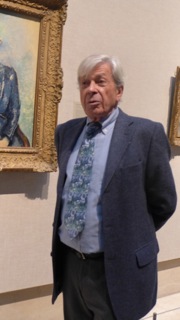
Philippe Cézanne, grandson of Paul Cézanne, at the Met's Madame Cézanne exhibition opening.

Philippe Cézanne, great-grandson of Paul Cézanne, at the Met’s Madame Cézanne exhibition opening.

Hortense and Paul’s descendants became a close family. While in his twenties Paul Jr.  became his father’s agent and advocate. He also took care of his often invalid mother, serving as a messenger between his parents. Paul Jr. married late in life and “begat” Jean-Pierre Cézanne, who “begat” Philippe. A retired art expert, he now lives in Aix-en-Provence, the Cézannes hometown, where he busily preserves and protects his great-grandfather’s memory. Five years ago he successfully prevented the French railroad from despoiling the landscape of the Mont Sainte-Victoire, the mountain memorialized by Cézanne more than 80 times. Philippe attended the opening events associated with the Madame Cézanne’s exhibition at the Met and contributed a chapter recounting the history of his family in the stunning catalogue accompanying the show.

Posted in Art review | Tagged , , , , , , , , , , , | 1 Comment

Leonard Lauder’s Cubist Art Collection at the Met

The eighty-one paintings by Georges Braque, Juan Gris, Fernand Léger and Pablo Picasso that are on view at the Metropolitan Museum of Art illustrate the birth of Cubism in Paris at the beginning of the 20th century. They are the promised gift of Leonard Lauder to his native city. By restricting his collection to four painters, Lauder was able to buy masterpieces.

Though American museums owe their preeminence to the gifts of the wealthy, it is rare to meet these benefactors in flesh and blood. At the opening press conference Lauder took pleasure in explaining that when he decided to assemble a world-class collection, Cubism spoke to him. He also wanted the caliber of each work to be such that it would be difficult for a museum director to “take it off the wall.” He achieved his goal.

Woman in a Chemise in an Armchair

Woman in a Chemise in an Armchair by Pablo Picasso

Lauder’s collection will catapult the Met to take its place among the very few institutions that own such extensive collections of nascent cubistic art; a style that America’s foremost museum was slow to embrace. The Lauder Cubist collection rivals MoMA’s which includes Les Demoiselles D’Avignon, the school’s best-known work. Among Lauder’s thirty-one Picassos are two preparatory studies for this work. Lauder’s collection also includes many unfamiliar works. Picasso’s pastel-colored Woman in a Chemise in an Armchair, with its “naughty,” non-deconstructed breasts and other realistic overtones, surprised me and I loved Braque’s Trees at l’Estaque.

Among the four painters Lauder collected, only Picasso would attain larger-than-life status. Inspired by Paul Cezanne, he and Braque created dozens of cubistic images that Henri Matisse characterized as consisting of “little cubes.” The name stuck and Picasso and Braque persevered. For many years the two painters visited each other’s studios daily and cooperated so closely that even professionals sometimes had a hard time telling their works apart. Their early works inspired Juan Gris, another Spaniard, and Fernand Léger, who developed variants. Juan Gris’s work, with its rounded edges and softer colors, is more lyrical. His intricate Still Life with Checked Tablecloth is a bravura achievement.

Léger has always gone his own way. The Lauder collection includes his appealing Composition (The Typographer). The very large canvas depicts a worker deconstructed into overlapping cones, cylindrical tubes, triangles, and semicircles. Its muted primary colors gladden the heart.

In his opening remarks Ronald Lauder stressed that he and his brother Ronald grew up in New York while the family’s cosmetic business was in its infancy. In his low-key manner he explained how New York City, with its then excellent public schools, museums and other readily available cultural offering, stimulated his and his younger brother Ronald’s devotion to art. (Ronald founded the Neue Galerie that showcases German and Austrian art.) Now in their eighties the “boys” are able to magnificently show their gratitude.

Cubism, on view until February 16, 2015, is both overpowering and difficult to comprehend, but it taught me a lot about the form that shaped much of the art of the twentieth century.

Posted in Art review | Tagged , , , , , , , , , , , , | Leave a comment

Ebola, Dr. Craig Spencer and American Hysteria

Dr. Craig Spencer

Dr. Craig Spencer

I spent the past week worrying about the health of Craig Spencer, that appealing-looking young man battling for his life at Bellevue Hospital in New York. He represents what is best about America and medicine. He used his resources to cure the ill to the best of his ability without regard to personal gain. As President Obama is fond of saying: “He put himself in harm’s way.” Craig deserves our concern as much as the other guys and gals we send to Iraq, Syria, or other places. The doctor did not catch Ebola during the time he was in Guinea and there was no particular reason for him to come down with the disease upon his return. When he did suspect—or realize—that he had contracted the disease, he exceeded protocol.

It is both our humanitarian duty, as well as in our practical interest, to combat, confine and eradicate the Ebola epidemic in West Africa as quickly as we can. If it continues to ravage there it is likely to spread beyond that region and that continent.

Epidemics are scary and unpredictable and can kill millions.

A quick search of the Internet revealed that the black or bubonic plague, which peaked in Europe from 1346 to 1353, killed between 75 to 200 million people (30 to 60% of the population). It is thought to have arrived from China via merchant ships on which sailors had been infected by rats infested by disease-carrying fleas. Quarantine measures failed.

A very deadly type of influenza—the Spanish Flu—infected 500 million people. It peaked from March 1918 to the spring of 1919 and killed 50-100 million individuals.

Like Ebola, both the plague and the flu kill quickly. However, unlike the Spanish Flu or the Black Plague, Ebola is much less infectious. It is not transmitted by air or water but only by close body contact or body fluids.

The AIDS epidemic began in 1979. Because of its long incubation time, its spread remained unnoticed for about ten years. It too is only transmitted by body fluids, and probably could have been contained, if stringent hygienic measures and wide education had been the order of the day. But the government was indifferent because initially, the HIV virus primarily infected gay men and drug users. By now, AIDS has infected a total of 78 million people, of whom 36 million have died.

Hysteria never helps resolve a crisis. As of now there are no effective drugs for the treatment of Ebola. Good supportive measures—intravenous fluids, oxygen, bed rest—all more effective when used early in the course of the disease—and good fortune, help.

Panic and hysteria are impediments to survival. Physicians and epidemiologists do not believe that the U.S. is currently at risk of a widespread epidemic and we have no choice but to believe them. Sealing our borders is not a real option. Borders are essentially porous.

If there is one guilty party in this story it is the halting of the development of an effective Ebola vaccine. Now drug companies are trying to make up for precious lost time. Such a vaccine would eventually solve the problem. Scientists have been good at eliminating major scourges like smallpox, rabies, polio, yellow fever, mumps, measles and even most forms of influenza. Specific medication would of course also solve the problem, but there are none for viruses, and none seems to be on the horizon. Until specific treatment is available, health care workers have to risk their lives and do the best they can. Let us all give them our blessing and support.

Major epidemics, like earthquakes, tsunamis, and draughts, are a reminder of the fragility of planet Earth. Ebola may be one of these catastrophes. Panic and irrationality are never helpful.

Posted in politics | Tagged , , , , , , , , , , , , , , , , , , | 5 Comments

Manhattan’s 86-Year Old Rudolf Steiner (Waldorf) School

The other day I hurried along East 79th Street on my way to the Met Museum when I glimpsed a likeness of Leonardo da Vinci paired with the promise of teaching the principles of the Italian Renaissance to children in elementary school. “How nice,” I thought, before realizing that it was the New York’s Rudolf Steiner School making this promise. I had a vision of myself, aged nine, attending a Steiner (Waldorf) School in Hanover, Germany.
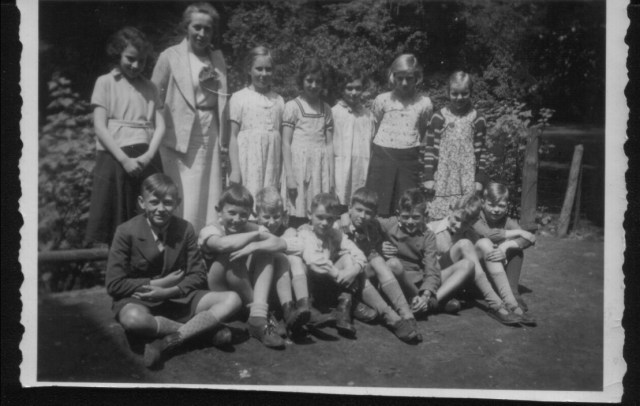
Suzanne Loebl's Waldorf class

My class at the Waldorf School in Hanover, Germany. I am third from the right in the top row.

Rudolf Steiner, an Austrian educator and philosopher, founded his first “Waldorf School” for the children of the employees of the Waldorf-Astoria cigarette factory in Stuttgart in 1919. Steiner developed many new methods of education, including attention to the capabilities of individual students, absence of grades, strong ethics, tolerance, a close relationship between teacher and student and immersion in particular subjects. The homeroom teacher, heading a particular class for eight years, taught history, mathematics, geography, anatomy or German every day for weeks at a time. The curriculum emphasized eurhythmics, a system of movements intended to promote musical understanding, anthroposophy, a deeply spiritual philosophy, music, and crafts. The school rapidly ran afoul of the Nazis, who eventually closed it. We read and wrote poetry, illustrated our essays, and yes, learned about the Italian Renaissance, as well as about Norse Gods, and the myths of other countries.

In my case, my parents did not select the Waldorf School because of its principles, but because it was willing to accept a Jewish kid like me in the Nazi-dominated Germany of the 1930s. In many respects the school fit me like a glove. I was smart and highly creative, but since I was slightly dyslexic, a condition not recognized then, I had a very hard time mastering the conventional subjects like reading, spelling, and arithmetic. I performed erratically because, I now believe, I also suffered mildly from ADD (attention deficit disorder). I often got and get lost when someone tries to teach me something complex. Even today, I learn best by figuring things out for myself.

I attended the Waldorf School for three years. Most everybody in my class was tolerant of me and of Ruth Iris, the other Jewish kid in my class. I was a loyal student, honestly believing that I loved the school and Herr Lange, our teacher. He actually was an actor and teaching was a second choice. He broke out in a sweat whenever he tried to teach us the rudiments of arithmetic, and I blame him for my lifelong difficulties with the subject.

It is only much later that I realized how deeply I hated growing up in Nazi-dominated Germany and how this included my attendance at the seemingly tolerant Rudolf Steiner school. With my mind’s eye I could “see” students and teachers thinking that I was “a nice little girl who was unfortunately Jewish.” I detested being special. I was relieved when we left Germany and I attended a traditional French lycée, though there too I was special, since to begin with I did not speak French. In Belgium some people disliked me for being German, others for being Jewish. By then, however, I was getting used to being different.

Unfortunately it is hard to evaluate the effects of a liberal education. As an adult I approve of many of Rudolf Steiner’s principles, some of which now permeate traditional education. I have done very well for myself in spite of a very spotty education. The creative aspects of the school fit my quirky intelligence. The homework assignments stressed long essays and fostered my verbal skills, and the absence of grades was good for someone with learning difficulties. I, however, missed the concrete evidence of grades that should indicate when making a special effort does pay off. I also question the eight-year-long relationship with one and the same homeroom teacher. What if a student does not get along with her or him? I was glad to leave the school when we left Germany and I entered the rather strict and conventional Lycée de Forest in Brussels.

It took decades for me to realize that it was not the Rudolf Steiner School I hated but growing up in Nazi Germany. Though I experienced only moderate antagonism and hatred, especially when compared with what was to come, these years left me with deep scars. It does not take much to make me again feel like a second-class citizen! I suspect that I have tons of soul-mates, since today half the world’s billions lord it over the other half, and there must be many children who are made to feel “inferior.”

Posted in Uncategorized | Tagged , , , , , , , , , , , , , , , , , , | Leave a comment