‘Kykuit: The Rockefeller Family Home’ at the French Institute Alliance Française (FI:AF)

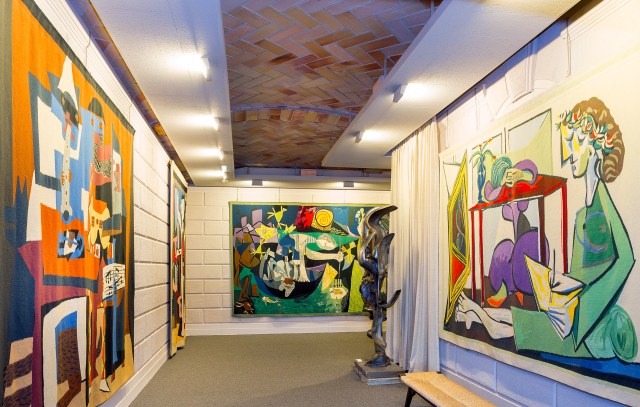
Picasso tapestries in the underground art galleries at Kykuit. (Photo © Jaime Martorano)

On the cusp of summer, the French Institute Alliance Française—one of New York’s oldest institutions, bonding the United States and France—invited Mary Louise Pierson to talk about the lavishly illustrated book she and her mother, Ann Rockefeller Roberts, published about her family’s weekend home in Pocantico Hills, NY. Mary Louise, a graduate of the Rhode Island School of Design, took the book’s intimate pictures; Ann Roberts Rockefeller provided the lively text. The book, published by Abbeville Press, is called Kykuit: The Rockefeller Family Home. I attended the lunch because the talk would remind me of the five years I spent researching and writing about the Rockefellers’ contributions to the American art world.

In 1893, soon after the center of his oil business shifted from Cleveland to New York City, patriarch John D. Rockefeller, Sr. bought the land on which the estate rests. For a while the senior Rockefellers lived in a house that came with the estate, but in 1902 his son, known as Junior, built an imposing Beaux Arts mansion for his parents. The house is located atop and named for Kykuit (Dutch for “lookout”), a hill that dominates its surroundings. Indeed, from certain vantage points, the visitor is awed by a view of the mighty Hudson.

The house is designed for summer living; the gardens that surround it are truly magnificent. Today Kykuit is a house-museum shaped by three generations of Rockefellers. Senior equipped it with an organ and a golf-course; Junior —whose favorite architect William Welles Bosworth, designed the gardens—gave it its regal character; and Governor Nelson A. Rockefeller, the last live-in Rockefeller, provided it with its final form. He removed the organ and also endowed it with a major 20th century sculpture collection. Nelson was Ann Rockefeller Roberts’ father and Mary-Louise’s grandfather,

During her presentation at FI:AF, Mary Louise emphasized her loving relationship with her grandfather and entertained the audience with personal stories. Assisted by MoMA’s René d’Harnoncourt, Nelson spent much time arranging his sculptures in their ideal location. One of Mary Louise’s stories involved a brotherly disagreement between David and Nelson Rockefeller on the subject of the noise and disturbance caused by a helicopter as it repeatedly adjusted the placement of a large Henry Moore sculpture while David played golf with important Chase Bank clients. Today Nelson’s sculpture garden, which includes works by Aristide Maillol, Pablo Picasso, Jacques Lipchitz, Gaston Lachaise, Elie Nadelman, Alberto Giacometti and many more, is one of the finest in America.

I identified with Mary Louise’s pleasure at photographing and illustrating Kykuit. I visited the estate repeatedly, and as well as most of the 37 other institutions that benefited from the Rockefeller’s financial largesse, hard work, and excellent taste, all recorded in my latest book, America’s Medicis: The Rockefellers and their Astonishing Cultural Legacy (HarperCollins). It was so much fun creating that book that I wish that I could do it all over again.

The elegant lunch provided by FI:AF matched the refinement of Kykuit. Each one of the dozen or so tables was napped by bright-blue tablecloths and highlighted by vases of tulips and shiny, stemmed wine glasses. The food was equally delicious, and the festivity of the penthouse space at 22 East 60th Street matched the excitement of the afternoon.

Posted in Art review | 2 Comments

An Announcement

As many readers of this blog know, I have written two memoirs. One of them, At the Mercy of Strangers: Growing Up on the Edge of the Holocaust, is an account of my experience as a hidden Jewish teenager during World War II. It relies heavily on my war-time diary, which I kept while I worked as a “mother’s helper” with false papers in Nazi-occupied Belgium, to tell the story of my family’s escape from Hitler, and our survival.

The other memoir is The Mothers’ Group: Of Love, Loss and AIDS. In 1983, my son David was infected with HIV. Almost 40 years after I escaped peril in Europe, I found life closing in on my family again. I once again kept a diary of sorts, and joined a group of mothers whose children were also affected by the then-fatal virus.

Of the 355 women who came through our group, every single one lost their child. My personal battle was over on May 24, 1993. A few years after I lost David, I sat down to write about the experience. The book is much more about life than about death. It is about David and his love of life, and about his generation in the gay community, for whom AIDS was a terrifying rite of passage.

Both of these books have been available in print for some time, but I am so glad to announce that my granddaughter Naomi has recently reissued them in digital form. In addition to the print editions, you can now order both memoirs as e-books from Amazon.com: At the Mercy of Strangers (Kindle edition); The Mothers’ Group (Kindle edition). You can also contact me at suzanne.loebl [at] gmail [dot] com for autographed, old-fashioned, lavishly illustrated print copies.

Posted in family stories, history | 1 Comment

On Ice Cream

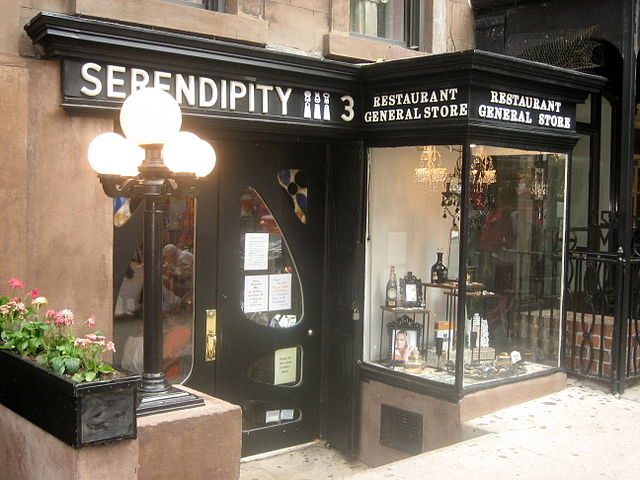
serendipity

All of us have foods that unleash floods of memories. For Marcel Proust it was Madeleine cakes. For me, one of those foods is ice cream.

I simply love ice cream. In my birth town of Hanover, it was only available in summer, when the local bakery made it once a week. We rushed over to buy it, and hurried home before it melted. Then, at my request, Mom, Dad, Anna the cook, Detta the nanny, and I all sat on the stairs of our creaky Victorian house, licking away at the cool Manna to our heart’s content.

I love all iced desserts. I date my first gourmet epiphany to a slice of Italian semifreddo studded with bits of candied fruit, nuts and chocolate. I have learned to make my own fruit ices redolent with kiwis or mango, and a praline soufflé dripping with calories. But I also swoon over a Good Humor bar—good vanilla ice cream with a hard coat of chocolate—or a sugar cone filled with Häagen Dazs.

When my children were young I discovered Serendipity 3, a dreamy confectionery on Manhattan’s East Side. It is filled with stained glass lamps, improbable sculptures, and other nonsense. The shop serves delicious chocolate and ice cream concoctions. We went to celebrate achievements and to mourn losses. Taking my grandchildren there a generation later was proof that I, an immigrant, was growing roots. Since Jacqueline Kennedy was said to have taken Caroline there, I even felt that I was part of New York City’s elite.

The other day I had to waste some time in the neighborhood and decided to revisit Serendipity. It had not been a good day and memories of my past happiness eluded me. I felt bereft. I love my daughter and my grandchildren, I thought, but they are too big and busy to appreciate ice-cream outings! What am I doing here all alone? Serendipity does not even carry decaffeinated coffee! Worse, unbidden, the memories of other ice cream-centered celebrations entered my consciousness.

In 1933, Germany turned ugly. Hitler despised Jews and it had become difficult for my mother to find a school that would accept a Jewish child. Finally the liberal Rudolf Steiner-Waldorf School did. The children were rather tolerant of Ruth Iris and me, their only Jewish classmates. In 1937 we accompanied the class on its annual school trip. When an SS member spotted the two of us at the inn where we were staying overnight, he insisted that we be sent home immediately because he “could not possibly sleep under the same roof as these Jew pigs.”

My parents fortunately owned a car and fetched us in the middle of the night. To console me my mom gave me a generous amount of cash to buy myself an ice cream sundae at Hanover’s beloved Eis Palast (ice cream palace). I did, but could hardly swallow my favorite food. I fervently wished for company with whom to share this adventure. In no way did the ice cream make up for the rejection and humiliation I felt after my ejection from the inn.

My family left Germany for Belgium in 1938; the Nazis invaded Belgium in 1940. Two years later my family started hiding in “plain sight.” By then I was old enough to work as a mother’s helper and during the next two years lived with four different families. Food was in very short supply, and ice cream unheard of. My mom learned of a pastry shop that for 50 francs clandestinely served Dame Blanche, i.e. a “black and white” hot fudge sundae. As a very special treat, my mom gave me the money.

Proudly I took myself to the pastry shop on the Rue du Bac in Brussels. The owner of the shop was surprised to see me and quite rightly demanded payment in advance. Knowing that in restaurants one pays after the meal, I was profoundly humiliated. Did the owner think that I was going to defraud her? Would I be caught eating contraband food? I paid up and when I was served that incredible frozen delight I felt awful. As in the Eis Palast in Hanover I felt like an orphan! I cried as I ladled the chocolate and vanilla concoction into my mouth.
Posted in family stories, history | 2 Comments

Farewell to David Rockefeller

David Rockefeller

David Rockefeller

One of the pleasures of being a biographer is that one becomes intimate with one’s subjects without really knowing them in the flesh. So it is, after spending five years writing America’s Medicis: The Rockefellers and their Astonishing Cultural Legacywith the Rockefellers and me.

In addition to writing the book I have always profited from Rockefeller benevolence. I enjoy the institutions they founded or supported—in America’s Medicis, I identify thirty institutions on which the family left its imprint. I enjoy the lands they donated for me to walk on in New York, Maine, and California. I am grateful for the medical research carried out at Rockefeller University, which improved the world’s health.

I also have some more personal connections. Both David and I own homes—he a substantial one, I a camp—on Mount Desert Island in Maine. I had the pleasure of meeting him on walks on Rockefeller land—he driving his magnificent matched pair of horses, I being led by my poodle; in restaurants; and even in line to use the bathroom at concerts at St. Savior’s Church in Bar Harbor.

David was the youngest and the longest-lived of the five amazing sons of John D. Jr. and Abby Aldrich Rockefeller. John and Abby somehow managed to bring their children up to be successful, mostly caring human beings even though their grandfather had been the richest man on earth. The boys learned to care about God, the beauty of the world, education and art. As Chairman of Chase Manhattan Bank, David managed to enlarge his considerable inherited fortune. He distributed some of it as he went along.

America’s Medicis concentrates on the family’s contribution to America’s art world. The Museum of Modern Art (MoMA) was David’s favorite. Abby co-founded it in 1919 and for decades “Mother’s museum” was Abby’s as well as Nelson Rockefeller’s principal concern. David’s first task for MoMA came in 1953 when he was put in charge of developing the Abby Aldrich Rockefeller Sculpture Garden, one of New York’s most beloved public spaces. The garden fills the lot formerly occupied by the Rockefeller houses on 54th Street. David’s involvement with the museum grew, as did his donations. He assumed the position of chairman of the board in 1962.  Like most museums MoMA often needed more money than it had, and single-handedly managed its finances in such a manner that it could become the mega-museum it is today.

David Rockefeller also assembled a great art collection. It includes work by nineteenth-century French paintings and more modern pieces. In 1968 MoMA was given the opportunity to buy Gertrude Stein’s collection. The museum did not have the funds to acquire it, but recruited five collectors, including Nelson and David Rockefeller, to buy it provided that they would will certain works to the museum. During the sale David acquired eight paintings by Picasso, including Girl with Basket of Flowers and The Reservoir, Horta de Ebro, both of which are destined for MoMA.

In addition to MoMA David had other institutional favorites that benefited from his largesse: Rockefeller University and Harvard University, his alma mater.

Thank you, David Rockefeller.

Posted in Uncategorized | Tagged , , , , , , | Leave a comment

Georges Seurat’s Circus Sideshow at the Met

Georges Seurat was a visionary. He applied primary colors in tiny dots, and ended up with unbelievably beautiful novel textures and shades. His technique was based on the theory of the color wheel and as a reaction to the spontaneous, loosely constructed images of the Impressionists. Seurat based his own figures on careful drawings made with a Conté crayon on rough paper, a technique that again resulted in a specific texture. They often look like abstract silhouettes, an impression enhanced in Circus Sideshow, on exhibit at the Met through May 29, by the ethereal illumination provided by the gaslights that line the upper edges of the painting.

hb_61.101.17.jpg

Circus Sideshow (Parade de cirque) by Georges Seurat (1887-1888)

In Circus Sideshow, the row of heads of the would-be clients frames the bottom edge of the mesmerizing painting. They wear assorted hats. A trombone player, his fellow musicians, a jester and the ringmaster all try to entice the crowd to pay a few pennies to enter the circus tent and see the actual show, which fills the body of the canvas. The picture is formally constructed, with strong vertical and horizontal divisions.

It is fitting that the Met displays Seurat’s Circus Sideshow in 2017, the last year that Barnum & Bailey and the Ringling Brothers’ “Greatest Show on Earth” will tour America. The circus, a word that has become synonymous with chaos and bedlam, is one of humanity’s oldest entertainments. Circus shows have changed little since the late 19th century when Seurat painted the Circus Sideshow (Parade de cirque) that depicts the free teaser meant to attract a paying audience.

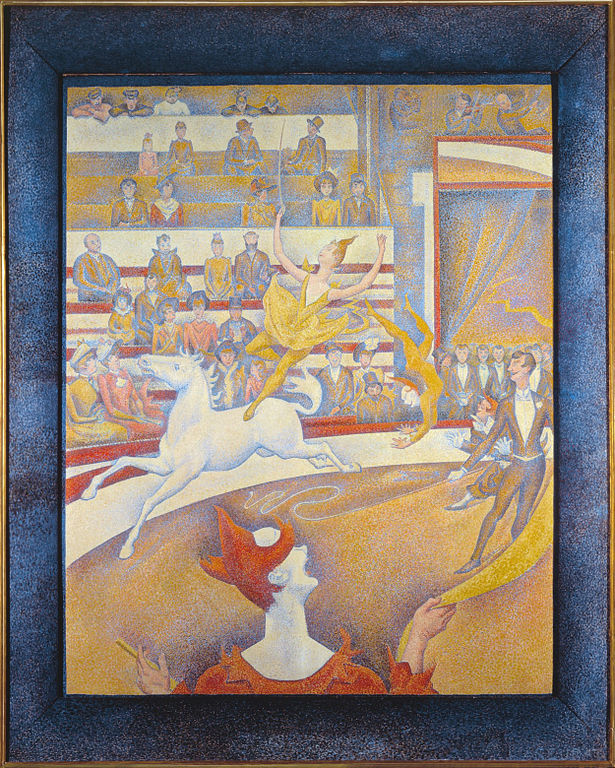
Seurat’s last painting, The Circus, is a joyous view of the performance inside the tent. Its most important feature is a triumphant woman balanced atop a galloping white stallion. The bleachers, filled with hatted spectators, emphasize the painting’s relationship to the Circus Sideshow.

Georges_Seurat,_1891,_Le_Cirque_(The_Circus),_oil_on_canvas,_185_x_152_cm,_Musée_d'Orsay.jpg

The Circus (Le Cirque) by Georges Seurat (1891)

At the time of Seurat’s death in 1891, no French museum owned any of his major paintings. John Quinn, an American lawyer who had assembled an amazing collection of modern paintings, left Seurat’s unfinished Circus to the Louvre when he died in 1924. The rest of Quinn’s collection was dispersed, and its sale may have been a contributing factor to the founding of the Museum of Modern Art in 1929.

At the current Met show, the Circus Sideshow is surrounded by contemporary drawings related to popular circuses and fairs. Many of these are by Seurat himself as well as by Honoré Daumier. There are many relevant posters and related paintings. The most amazing of these is Fernand Pelez’s gigantic Grimaces et Misère: Les Saltimbanques, which gives us a very realistic view of a typical circus troupe with its dwarf, clowns and musicians with their brass instruments. As its title implies, the sad faces of the performers illustrates the tragic aspect of people being amused by misfits.

800px-grimaces_et_miseres_-_les_saltimbanques_by_fernand_pelez

Grimaces et misères: les Saltimbanques by Fernand Pelez

Seurat died at just 32 years old, leaving the world seven large paintings and about forty smaller works. His best-known work is A Sunday Afternoon on the Island of the Grande Jatte, now owned by the Art Institute of Chicago. Given such a small output it is surprising that his technique—Neo-Impressionism, pointillism or divisionism—exerted a major influence on the future of the art world.

Posted in Art review | Tagged , , , , , , , , , , , , , , , , , , , , , , , , , , , , | 2 Comments

Planned Parenthood and The Marseillaise: Aux Armes, Citoyens!

womens_march_washington_dc_usa_33

To arms, citizens,
Form your battalions
Let’s march, let’s march
Let an impure blood
Soak our fields

This is the refrain of the Marseillaise, forever the battle-song of oppressed humanities. It was composed by Claude Rouget de Lisle in 1792 shortly before the French Revolution and popularized by a battalion of Marseille soldiers as they marched to Paris to help in overthrowing the aristocracy. It became France’s national anthem.

The song could very well have been sung by us, millions of women in our pussy hats, as we marched on January 21st in Washington, DC and in all of the major American cities.

We marched because the Trump administration is likely to interfere with the progress we have made: wages, medical care, domestic violence legislation, school lunches, and so much more.

We also marched because of the threat to that which has protected women’s health for a century:

Planned Parenthood.

It has helped us to plan our children so that as responsible mothers we could give birth to them whenever we could best care for them.

It is not that women ignored spacing and planning the children they bore before the birth control movement existed. To do so a hundred years ago many women, especially the poor, had to rely on shoddy and self-inflicted abortions. Many died in the process.

In 1916, Margaret Sanger, a nurse who had witnessed many such needless deaths, established a birth control clinic in Brownsville, Brooklyn. There she taught walk-ins who wanted to learn “how to stop the babies from coming” everything she had learned about reliable birth control methods in Holland. That country had such counseling centers before World War I.

The police closed Sanger’s clinic after a few days and she ended up in jail, where she rapidly befriended her fellow inmates. On March 6, 1917, Margaret Sanger’s prison sentence was up. As she recalled later in her autobiography:

Through the metal doors I stepped and the tingling air beat against my face. No other experience in my life has been like that. Gathered in front of me were my old friends who had frozen through the two hours waiting to celebrate ‘Margaret’s coming out party.’ They lifted their voices in the Marseillaise. Behind them at the upper windows were my new friends…and they too were singing. Something choked me. Something still chokes me whenever I hear that triumphant music and ringing words: ‘Ye sons of freedom wake to glory.’

After prison Margaret Sanger abandoned guerrilla tactics and fought for the right of women to access comprehensive birth control throughout the court. She succeeded, but access has always been a somewhat thorny issue. Only recently has it become part of most healthcare plans.

During his first week in office President Trump is targeting the free birth control provision of the Affordable Care Act. Just as shocking is the fact that he revived the ban on providing foreign aid to groups that provide abortion counseling. Are we going back to unwanted children and self-induced abortions?

We might very well. Anti-abortion, right-to-lifers marched in Washington less than a week after the Women’s March. Their placards defamed Planned Parenthood. They were addressed by Vice President Mike Pence. They are targeting Roe v. Wade, which is the ruling that for decades has given every woman the right to a legal, safe abortion. Women, hurry to the barricades!

Posted in politics | Tagged , , , , , , , , , , , , , , , , | 2 Comments

Farewell to a Gentler America

Barack_Obama_family_portrait_2011.jpg

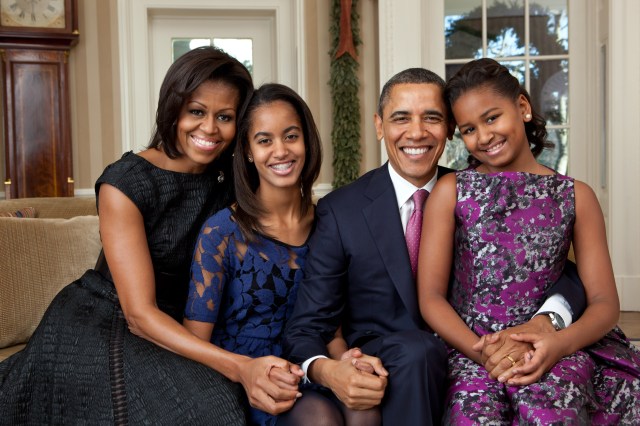
We are about to say goodbye to a president who conquered the highest office in America even though his father was not only foreign-born, but also black. It was a rare achievement for a country so divided between liberals and conservatives, the desperate and the misinformed. It was good to know that during the past eight years, a loving family occupied the White House. Barack Obama was a rare politician: sincerely trying his best to keep us safe, content with his salary check, and in love with his wife. He valiantly struggled with the country’s thorny problems: immigration, healthcare, economic inequality, and climate change. None of these are easy to resolve or necessarily of America’s making, rather a byproduct of modern life—but America’s legendary kindness, generosity and resourcefulness could, and sometimes did under President Obama, alleviate their impact.

Personally I am most familiar with immigration. As readers of Branching know, as a child I was caught in one of the world’s previous refugee crises. I immigrated to the United States in 1946. It was the end of my Odyssey. In 1938 the Nazis had kicked my family out of Germany; the Belgians had sheltered us during the Holocaust, but would not grant us permanent residency nor permit us to become citizens. So it was lucky that we could move to New York. I came reluctantly. I viewed my future countrymen as “ugly Americans” who had more than the rest of the world and were arrogant about it. It took me some time to appreciate the fact that once I arrived I had equal rights and the possibility to have a pleasant, normal life.

Some of my realization of how unique the United States was in that respect came from the story of my young cousin Jorge. Born in the Czech Republic to German parents, he had legally arrived in Mexico at the tender age of three. When he was eighteen he still was a foreigner. When he wished to study abroad he could not apply for any of the many available scholarships because he was not a Mexican citizen. Jorge fell in between the cracks. The United States grants citizenship after five years or even sooner. My sister obtained a full scholarship to Yale four years after we arrived in the United States.

Somehow, in spite of much opposition, the people who governed America during much of its existence have managed to share America’s pie more equally. We not only grant citizenship, but also developed an imperfect safety net. We have social security, public schooling, affordable healthcare for many, maternity and paternity leave, school lunches, and much more. The system is flawed, but we cannot dismantle it without throwing the country into complete disarray.

I hope that the new administration will think long and carefully about what it does. A look at some of our neighbors indicates how quickly a country can tumble from prosperity to insolvency and chaos.

Posted in politics | Tagged , , , , , , , , , | 3 Comments

2016: Christmas Cheer on Fifth Avenue


IMG_0909.JPG

It may be a hopeful sign that New York’s prime shopping boulevard is defying the political unrest that is settling on the world. The city’s big stores came up with an enchanting extravaganza of Christmas windows endowing Midtown Manhattan with a festive air. Tourists have not yet arrived for the holiday madness and the streets are manageable.

It is fitting that Branching’s editor Naomi and I started out with Tiffany’s, located on the ground floor of what has been called “White House North.” A whole platoon of New York City policemen guarded the entrance to Trump Tower. They efficiently shuffled us in front of the store’s diminutive boutique windows filled with Christmas trees hung with long pearl necklaces paired with stunning jewels. My favorite window consisted of a small crystal cityscape reminiscent of New York, fronted by a rolling sea and backed by continuous fireworks.

More police helped us cross Fifth Avenue and 57th Street. Bergdorf’s windows, called Destination Extraordinary, were as gigantic as the windows at Tiffany’s were small. My favorite was a parasol-bearing woman balancing in high heels on a rope strung across a pond filled with fish and alligators. In another window, an equally fashionable creature caught butterflies amidst gigantic praying mantises and other insects. We also loved the jungle with orangutans and a woman valiantly riding a relative of a llama.

IMG_0876.JPG

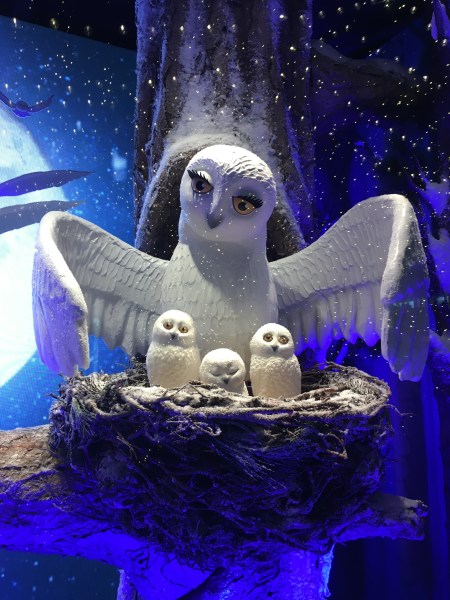
Lord and Taylor, in a marked change from its usual Old New York windows displayed an Enchanted Forest. We loved the den of foxes hibernating below frolicking raccoons, while a moose and its young lazily patrolled the forest. A sleepy giant brown bear filled an entire window. The dozen mice that surrounded him or her did not perturb the animal. I loved the mama owl that protectively wrapped and unwrapped her wings around her three chicks. The bird’s mascaraed lashes were an advertisement for the store’s cosmetic department.

IMG_0896.JPG

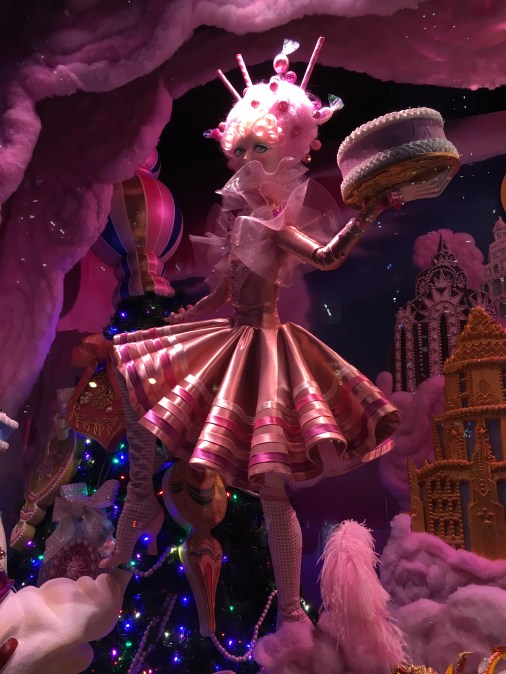
Saks Fifth Avenue’s Land of 1000 Delights featured Tchaikovsky’s Nutcracker and paid tribute to the holiday’s penchant for sweet treats. Clara and her Nutcracker/prince battled and vanquished the mouse king. I loved the sugar plum fairy in her tulle gown and the two giant golden cups of chocolate overflowing with whipped cream. Saks’ block-long façade displayed a magic light show. To see it, one must cross over to Rockefeller Center’s Channel Gardens, from where one also has a good view of the Center’s traditional Christmas tree.

IMG_0913.JPG

Time to go home unless you want to stop by and pick up a strand of “pearls” at a makeshift Christmas market—in case Tiffany’s prices stopped you from getting the real stuff. The market is located on a vacant lot near 45th Street that will soon, no doubt, anchor another tower.

Posted in Uncategorized | Tagged , , , , , , , , , , , , , , | Leave a comment

Olga and Serge Blumenfeld: Lifelong Friends

photo

Photo courtesy of Carole Blumenfeld

I met Olga almost seventy years ago in Dr. Bodansky’s clinical laboratory at the Sloan Kettering Institute for Cancer Research (SKI) in New York City. During the first four years of our friendship, we spent our entire working week together. In between laboratory experiments we had plenty of time to talk about our past, present and future. Olga and I had much in common. She had been born in Poland, I in Germany. With our parents we fled the anti-Semitism of our native countries and grew up in Belgium. After the Germans invaded Belgium, Olga’s family managed to leave for the United States via one of the last boats to depart from Western Europe.

One day aboard ship Olga heard someone whistle Mozart’s A Little Night Music. She whistled back and soon met Serge Blumenfeld, a medical student and the drop-dead handsome nephew of Chaim Weizmann, the future president of Israel. Olga thought theirs was only a shipboard romance, but Serge called her soon after they both settled in New York.

Serge’s path was rather smooth. He was admitted to New York University Medical School and specialized in internal medicine. A dozen or so years later he opened a private practice in Tarrytown, NY. For years he also took care of the health of the Tarrytown police force.

Olga’s family had a harder time. Her father, David Opochinsky, an engineer, worked nights at a dairy. Her mother stitched gloves in a sewing factory. Olga went to City College. She married Serge in 1944 and earned a master’s in biochemistry while he was doing his military service in Colorado. Then they returned to New York: Serge to complete his medical training and Olga to work as a research assistant at SKI. In 1951, Olga went back to school—a brave decision for a woman during the early 1950s. She earned a doctorate in biochemistry at NYU, took a job at Rockefeller University and after many years became a professor at Albert Einstein Medical College. There, she did groundbreaking work on the surface of red blood cells. In 1999, with the technical help of Dr. Santosh Patnaik, she developed the Blood Group Antigen Gene Mutation Database, which would make blood transfusions safe in selected cases. In 2002, the American Association of Blood Banks (AABB) awarded her a major prize. She continued to curate her database to the end of her life.

It was her roles as a daughter, wife, mother—their son Philip was born in 1952—grandmother and friend that were the glue of Olga’s life. She always was modest and retiring. She always claimed that she could not cook; yet she served delicious food. Serge, a connoisseur, saw to the wine, and looked after Vicky, Lexie, Tiffany, Angelika, Serafina and other good-natured golden retrievers. Friends always filled their magic house in the Sleepy Hollow section of Tarrytown. Everyone admired Olga and Serge.

I too loved visiting. “Make it comfortable,” Serge had said to Olga when they bought the house some fifty years ago. She did, though it also was elegant, reflecting their European roots. There was a magnificent old chandelier the Blumenfelds had dragged from France, and formal French furniture in the living room, but most often we sat on an enclosed terrace protruding into the garden, drinking wine Serge had imported from his native France, the dogs lolling at our feet. Another small glassed-in terrace served as Olga’s office, the only token of her professional activity.

She and I talked endlessly of the past, people we had known, experiences we had shared. I have an amazing memory for small details, and often remember things about people they have forgotten themselves. Olga and I reminisced about the times when we bought Philip’s layette or my wedding dress on our lunch breaks. A project of mine required my using the Rockefeller Archives in Pocantico Hills, and for awhile I bunked at the Blumenfelds’, recapturing some of the closeness of our days at SKI. Before I got up, Olga would prepare a breakfast that included grapefruit, croissants and the New York Times.

In 2014 Olga gave a joint party for Serge’s 95th birthday and their 70th anniversary party. Olga thanked each one of her thirty or so guests for having shared their lives. It was almost a farewell. Very slowly, almost imperceptibly, Serge’s mind had clouded over, though he remained a gentleman to the end. Six months after the party he stopped talking and took to his bed. Olga, by then herself plagued by various ills but assisted by health aides and her housekeeper Pat, cared for him until the end of September 2016. Then Serge left us. Two weeks later Olga had more stomach pain than usual. Philip took her to the emergency room at Phelps Memorial Hospital. Three weeks later, she too closed her eyes. It was as if she had willed herself to live as long as she was needed.

I miss her terribly. Every few days I remember that I have not talked to her in awhile. Each time something good or bad happens to me I think that I must tell Olga. I wish that I could.

Posted in family stories | 4 Comments

Max Beckmann at the Metropolitan Museum of Art

1-max-beckmann-in-new-york_beckmann_self-portrait-in-blue-jacket_saint-louis-art-museum_custom-cc0c61a6fd48edadef97389f02bc12daacf9110d-s300-c85

Self Portrait in Blue Jacket (1950), by Max Beckmann. (Saint Louis Art Museum)

“Thank God this painting is in New York,” Sabine Rewald kept repeating as she led a flock of reporters through the magnificent exhibition of Max Beckmann paintings that she had curated for the New York’s Metropolitan Museum of Art. Given the fact that Max Beckmann’s paintings were declared degenerate by the Nazis in 1933 and therefore in great danger of being destroyed, Rewald’s remarks were not parochial. The Met’s current exhibit celebrates Beckmann’s end of life residency in New York City. The exhibition runs from October 19, 2016 – February 20, 2017.

Most works in the exhibit were either painted during the artist’s two-year-long New York residency and/or are owned by the city’s collectors and museums. New York was not the only American city to embrace Beckmann. The Saint Louis Museum of Art owns the largest collection of Max Beckmann paintings in the world.

In 1933, Beckmann was at the height of his career and many critics considered him Germany’s most significant painter of the twentieth century. The Nationalgalerie in Berlin devoted an entire gallery to his paintings, subsequently dismantled by the Nazis. The Bark, part of the current exhibit, entered the German museum in 1927. Because it was judged degenerate, Beckmann exchanged it for two more traditional works in 1933. These lasted in the Berlin museum until 1937. A U.S. collector bought The Bark in 1946. The image consists of a towering group of six individuals crowded in a sailboat. Quappi Beckmann, his beloved second wife who is drying herself after a swim, heads the group.

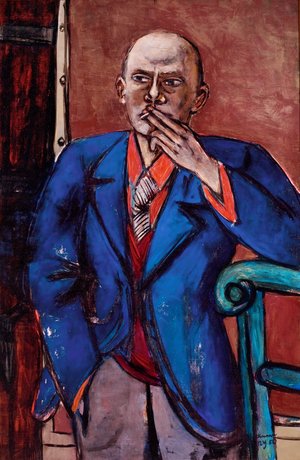
Beckmann painted a great number of self-portraits. During the first part of 1950 he painted Self-Portrait in Blue Jacket, which features him puffing on his ubiquitous cigarettes, his hand in his pocket, his jacket and shirt fitting his frame loosely. The Met featured the new work in an exhibit called “American Painting Today 1950,” a title that indicated that the museum considered Beckmann an American artist. On the morning of December 27, two weeks after the opening, Beckmann set out from his apartment on the Upper West Side to see the painting. He suffered a fatal heart attack before reaching the museum.

3-max-beckmann-in-new-york_beckmann_self-portrait-with-horn_neue-galerie-new-york-and-private-collection_custom-659c0691cfbcb86c735f49d7606893643d93932e-s800-c85

Self Portrait with Horn (1938), by Max Beckmann. (Neue Galerie New York)

The Museum of Fine Arts in Boston owns Beckman’s best known Self-Portrait in a Tuxedo (not in the Met’s exhibit). The almost as famous Self-Portrait with Horn, in which the painter seems to listen intently to his beloved instrument, is on view because it belongs to the Neue Galerie in New York. It too is a moving rendering of the painter as observed by himself.

4-max-beckmann-in-new-york_beckmann_family-picture_museum-of-modern-art-new-york_custom-34195e99536d9aa3c929d927ae3fbe26e594979f-s800-c85

Family Picture (1920), by Max Beckmann. (Museum of Modern Art)

Both Beckmann and his horn appear in a 1920 Family Picture. The portrait also depicts his first wife Minna—viewed from behind, completing her toilette—her mother, sister, and Peter Beckmann, the artist’s son. Candles, a newspaper, a small dog and other typical Beckmann paraphernalia complete the picture. It is an amusing work, reflecting on the disorganized nature of many family get-togethers. As Sabine Rewald points out in her fascinating catalog, J.B. Neumann, Beckmann’s dealer, included Family Portrait in the artist’s first New York solo show in 1927. Abby Rockefeller bought it at the suggestion of Alfred Barr and it now belongs to MoMA.

I was particularly moved by The Old Actress. The severity of her white hair is balanced by a loose wisp; an enormous nose and closed eyes reflect the dignity of old age. The unknown woman wears an elegant but simple black dress relieved by white cuffs and a lace blouse. Her typically large Beckmann hands clutch a cat. The primary colors—the yellow background, the red upholstery of the chair, the black and white of the dress—enhance the drama of the silent figure. Abby Rockefeller also bought this painting in 1930.

MoMA’s Departure triptych also made the show. It was painted in Frankfurt and Berlin during the late 1930s. Ever since, the meaning of its strange imagery—king and queen, oarsman, torturers and tortured—has escaped scrutiny. By declaring that it was scenery for King Lear, Beckmann managed to take Departure with him to Holland, where he spent the war years. It arrived in New York in 1938 at the gallery of Curt Valentin. Alfred Barr bought it for MoMA in 1942 even though, when approached, Beckmann refused to provide him with an explanation of what it meant and wrote Valentin a letter:

“Remove the painting or return it to me, dear Valentin…It can speak only to people who, consciously or unconsciously, carry within themselves the same metaphysical code…Departure. Yes, departure from the deceptive appearances of life toward essential things…” (Letter from Beckmann to Curt Valentin, quoted by Sabine Rewald in Max Beckmann in New York, Metropolitan Museum of Art, 2016)

There is something very German about many of these paintings that touched me profoundly and rekindled the feeling I had for my German childhood books and scary Grimm fairytales. It so happens that Beckmann’s (1884-1950) and my father’s (1887-1949) lives overlapped almost completely. When they were young both served in the medical corps of the German army during World War I. Beckmann had a nervous breakdown; my dad fared better. The Nazis destroyed their existence in Germany when they were middle-aged, but in spite of their age they rebuilt it abroad, before dying of heart attacks in New York in their sixties. Both were honest to a fault, as evidenced in The Old Actress, and seem to have possessed that special brand of German satirical humor, as demonstrated in Family Picture.

Posted in Art review | Tagged , , , , , , , , , , , , , , , , , , , | 1 Comment